
As the world grapples with the mounting challenge of plastic waste, chemical recycling has emerged as a promising solution to transform discarded materials into valuable resources. At the heart of this transformation lies catalysis—a science that enables complex chemical reactions to occur efficiently and selectively. Ketjen, a global leader in catalyst technologies, is pioneering innovations that make chemical recycling not only feasible but scalable and economically viable.
With over five decades of experience in catalyst development, Ketjen has evolved alongside the refining and petrochemical industries. Today, the company is leveraging its deep expertise to support the transition toward circularity, helping customers convert waste plastics into new monomers and chemicals using existing infrastructure.
The Catalysis Behind Chemical Recycling
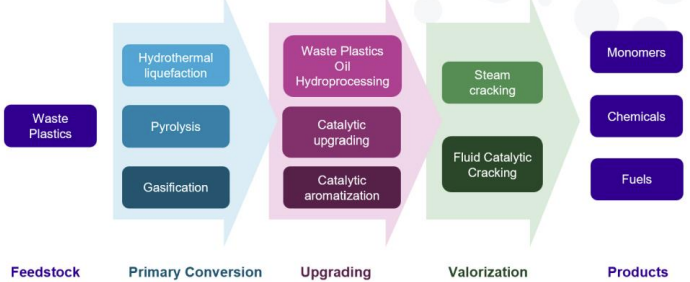
Chemical recycling involves breaking down waste plastics into its molecular components, which can then be reprocessed into new materials. This process typically unfolds in three stages: primary conversion, upgrading, and valorization, as illustrated in Figure 1. In each of these stages, catalysis can be applied to increase yields or the value of the products formed.
Conversion: Enhancing Pyrolysis
In the primary conversion stage, technologies such as pyrolysis, hydrothermal liquefaction, and gasification are used to decompose plastic polymers into smaller fragments. The oil or gas products that are formed in this step, however, are often impure and chemically unstable, requiring further treatment before they can be integrated into downstream processes.
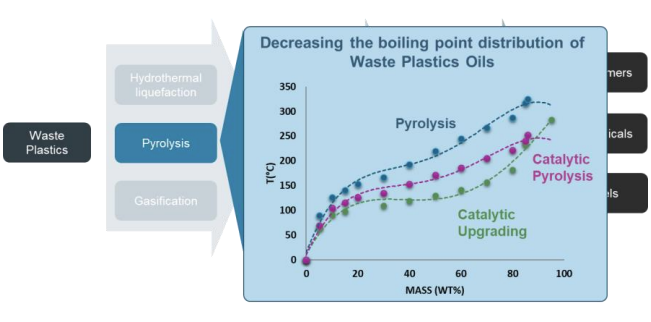
Ketjen’s joint venture in Brazil has developed catalytic pyrolysis technologies that significantly improve the quality of pyrolysis oils. By introducing catalysts directly into the pyrolysis reactor, the boiling point distribution of the resulting oil is lowered, increasing the fraction suitable for steam cracking. A subsequent catalytic step involves feeding the oil vapors over a fixed-bed reactor, where olefins are isomerized into paraffins. This transformation yields a highly paraffinic oil with excellent properties for downstream processing.
Upgrading: Circular Aromatics
Upgrading is the second stage, where catalysts play a crucial role. Through hydroprocessing and catalytic upgrading, impurities are removed, molecular structures are modified, and the chemical properties of the intermediates are tailored to meet the specifications of existing assets for monomer production like steam crackers and FCC units.
In collaboration with BioBTX, Ketjen is advancing catalytic aromatization technologies. These processes convert pyrolysis vapors into aromatic compounds such as benzene, toluene, and xylene—key building blocks for the chemical industry. A 20 kt/y plant in the Netherlands is currently under development, showcasing the commercial potential of this approach.
Valorization: Maximizing Circular Monomer Yields
Finally, in the valorization stage, the refined products are fed into conventional petrochemical units to produce monomers, fuels, and other valuable chemicals. This integration allows for the creation of circular products without the need for entirely new infrastructure.
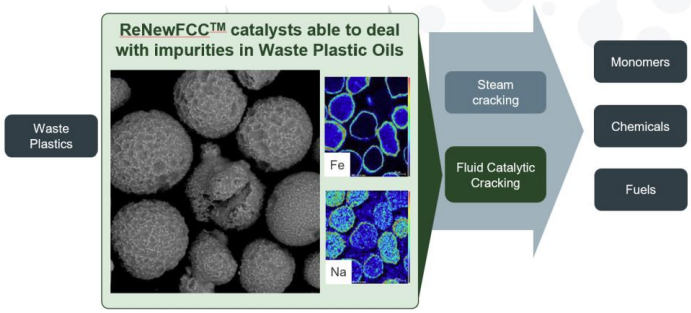
Besides fuels, Fluid Catalytic Cracking (FCC) units generate significant volumes of monomers, particularly propylene. Ketjen’s ReNewFCC™™ catalysts are designed to optimize monomer yields when co-processing WPOs. These catalysts are resilient to the inorganic contaminants commonly found in waste plastics, such as iron and sodium, which can otherwise deactivate conventional FCC catalysts.
By carefully designing the porosity and composition of the ReNewFCC™ catalysts, Ketjen ensures that the active sites remain accessible, even in the presence of high impurity loads. This innovation enables refiners to incorporate recycled feedstocks into their operations without compromising performance or product quality.
Waste Plastic Oils as a New Feedstock
By the creation capacity for the conversion of waste plastics, significant volumes of Waste Plastic Oil (WPO) will become available as feedstock for the chemical industry in the coming decade. Hydroprocessing is going to be crucial for unlocking the value of this new raw material, as it is a proven technology for the effective removal of impurities and the modification of product properties.
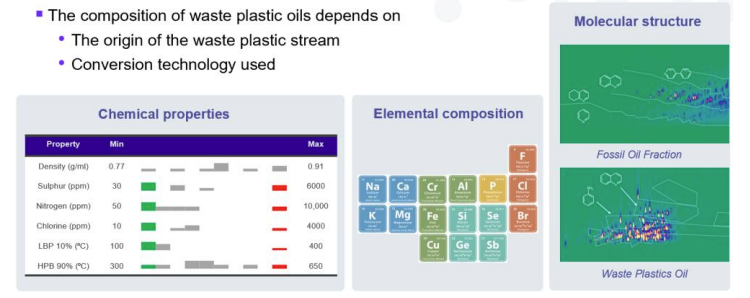
A critical aspect of catalyst development of this application is understanding the feedstock. Ketjen employs multi-dimensional chromatography and elemental analysis to characterize WPOs, which can vary widely depending on the source and conversion technology used. These oils often contain a complex mix of molecules and contaminants, including additives from the original plastics. Accurate profiling of these components is essential for designing catalysts that can effectively process the oils without degradation or loss of activity.
Ketjen’s Catalyst Innovations for WPO Hydroprocessing
Ketjen’s contributions to WPO hydroprocessing are anchored in its advanced catalyst systems, which are designed to address the unique challenges posed by these feedstocks. These oils differ significantly from fossil-derived feedstocks in terms of composition, reactivity, and impurity levels.
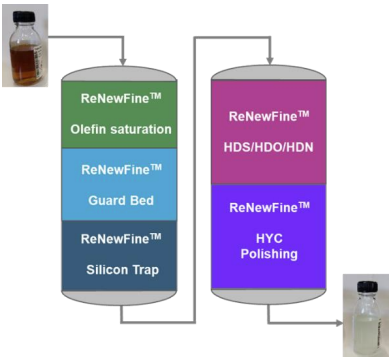
A complete portfolio of ReNewFine™ catalysts was developed specifically for the hydroprocessing of WPOs. These catalysts are engineered to stabilize reactive molecules such as di-olefins, which can otherwise lead to fouling and catalyst deactivation. They also feature a range of guard bed catalysts that trap inorganic impurities like phosphorus and silicon, ensuring smooth operation and long catalyst life.
Hydrocracking capabilities within the ReNewFine™ system allow for precise control over boiling point distributions, enabling the production of feedstocks suitable for steam crackers. Depending on the desired end product, additional steps such as deep hydrogenation or isomerization can be employed to fine-tune the chemical properties of the output.
Integrated Catalyst Systems
Ketjen’s approach to WPO hydroprocessing is holistic, involving integrated catalyst systems tailored to specific feedstocks and desired outcomes. A typical system may include multiple reactors and will certainly contain different catalyst beds, each serving a distinct function—from stabilization and impurity removal to hydrocracking and product customization.
This modular design allows for flexibility and scalability, enabling customers to adapt the system to their unique operational needs. Ketjen works closely with partners to deliver ReNewFine™ catalyst solutions as part of turn-key solutions.
Conclusion
Chemical recycling represents a vital pathway toward a more sustainable and circular economy. Through its advanced catalyst technologies, Ketjen is enabling the transformation of waste plastics into high-value products, helping industries reduce their environmental footprint while maintaining economic viability.
By integrating recycled feedstocks into existing assets, Ketjen’s solutions offer a pragmatic and impactful approach to sustainability. As the demand for circular products continues to grow, catalysis will remain at the core of innovation—and Ketjen will be there to lead the way.
By Jaap Bergwerff, Business Development Director Renewables